A bespoke firm that runs on rails.
Firm-grade work product at machine speed, behind a gate that refuses to let anything unproven leave the building. Speed and accuracy — not a trade-off.
- 9,427,210
- opinions, read in full
- 36
- actions tracked per matter, P0–P10
- 75
- examinations before a filing leaves
- 557
- safeguards proven on wrong input
The product, running
The application, as it runs.
The desk, the matters, a matter opened, its documents searched page by page, the filing checks, and the same practice on a phone.
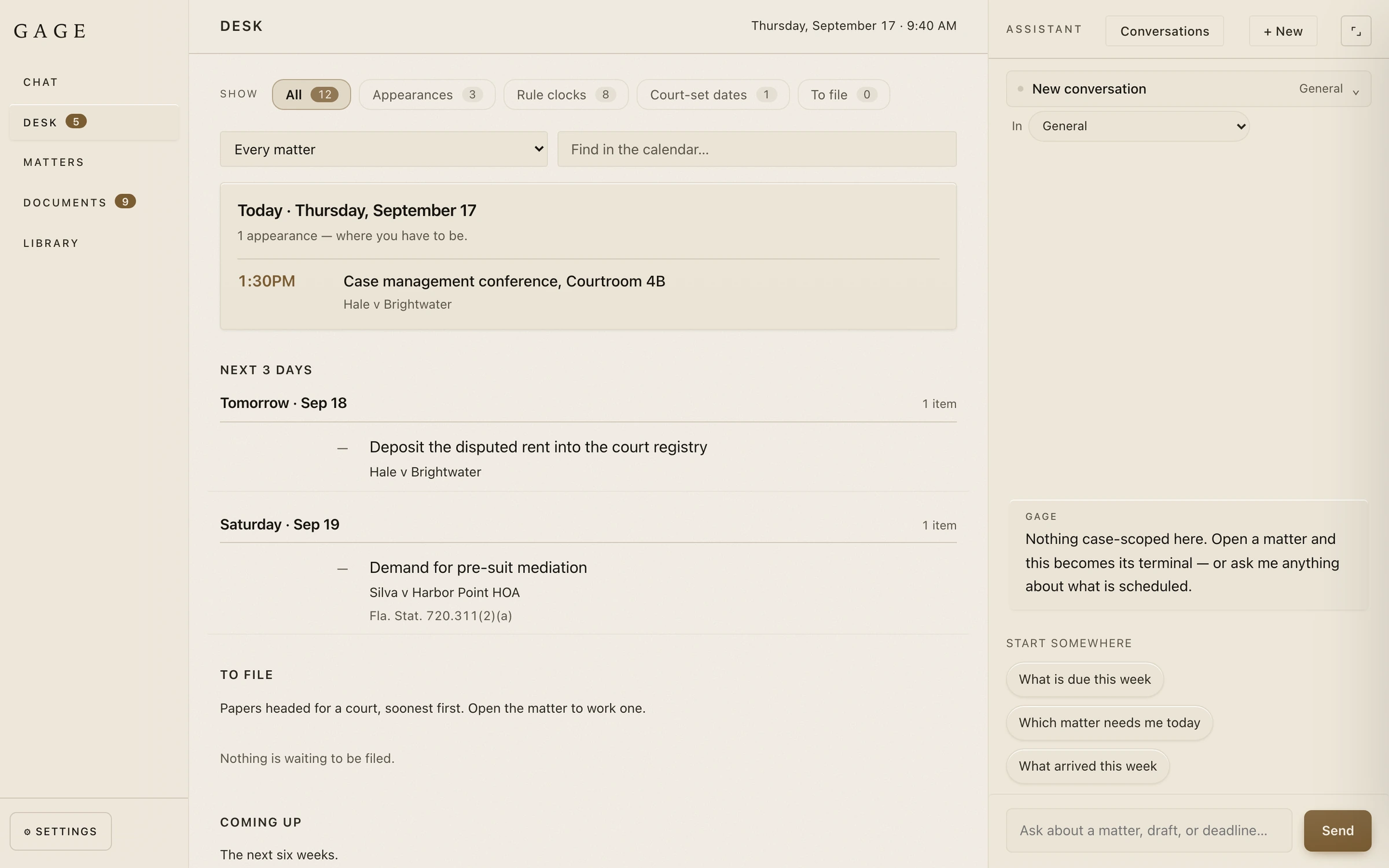
Every clock, in one place
Rule clocks, court-set dates and appearances across every matter, soonest first. Each date carries the rule that sets it, so you can check the arithmetic instead of trusting it.
- Filters that mean something: appearances, rule clocks, court-set dates, papers to file.
- Ten matters on one screen, ordered by what is closest, not by what was opened last.
74 stages stand between a draft and a court.
Every one of them is invoked on every paper — authority, argument, form, forum, sources, exhibits, service, dates, parties and numbers, each measured on the finished page. Below is a single draft. The stages named are the ones that returned a finding on it; the rest ran and passed, which is what passing looks like.
18
Authority and citation
15
Argument and craft
9
Form, forum and filing
8
Source and provenance
7
Adversarial review
5
Exhibits and service
5
Release control
3
Dates and clocks
2
Parties and privacy
2
Numbers
What each stage tests is not published. The count and the lanes are, because a client is entitled to know how much stands between a draft and a clerk.
Motion for summary disposition — commercial lease
5 stages shown · 1 stop
Standard of review statedclear
Fed. R. Civ. P. 56(a), reviewed de novo, with the authority that sets it.
Burden statedclear
Movant carries the initial burden; it does not shift until met.
Read-first provenanceclear
11 of 11 cited opinions read in full and logged.
Holding matchstops the filing
Marchetti is cited for a proposition the majority did not reach. It appears only in the concurrence.
Opponent engagementlook
Their brief cites 14 authorities. This answers 9. Five are unaddressed.
A recorded demonstration on invented papers.
What you receive
i
The matter, held whole
Parties, docket, deadlines, authorities, evidence and the service record are one file on your machine — not an account you rent. Every session opens already knowing the case; you never brief it again from the beginning.
ii
The clocks, computed from the rule
Response windows, objection and waiver periods, reconsideration and appeal — each derived from the forum’s own rule and carrying that rule’s citation, so a date can be checked rather than trusted.
iii
The case, built
Facts chained to the exhibit that proves them, a timeline that every event writes to, discovery graded against the responding forum’s standard, and exhibit binders with covers, numbering and redaction applied by machine.
iv
Research that reads the opinion
Statute, court rule, binding case law, the equity behind them, and the authority that runs against you — opened and read in full across 9,427,210 opinions and 77,481,570 citation links between them. A holding is never read alone.
v
The paper, rendered to the forum
Complaints, motions, answers, declarations and letters in the form the forum expects — standard of review, burden and relief stated in terms, citations resolved against 18,123,757 reporter entries before they reach your page.
vi
The refusal
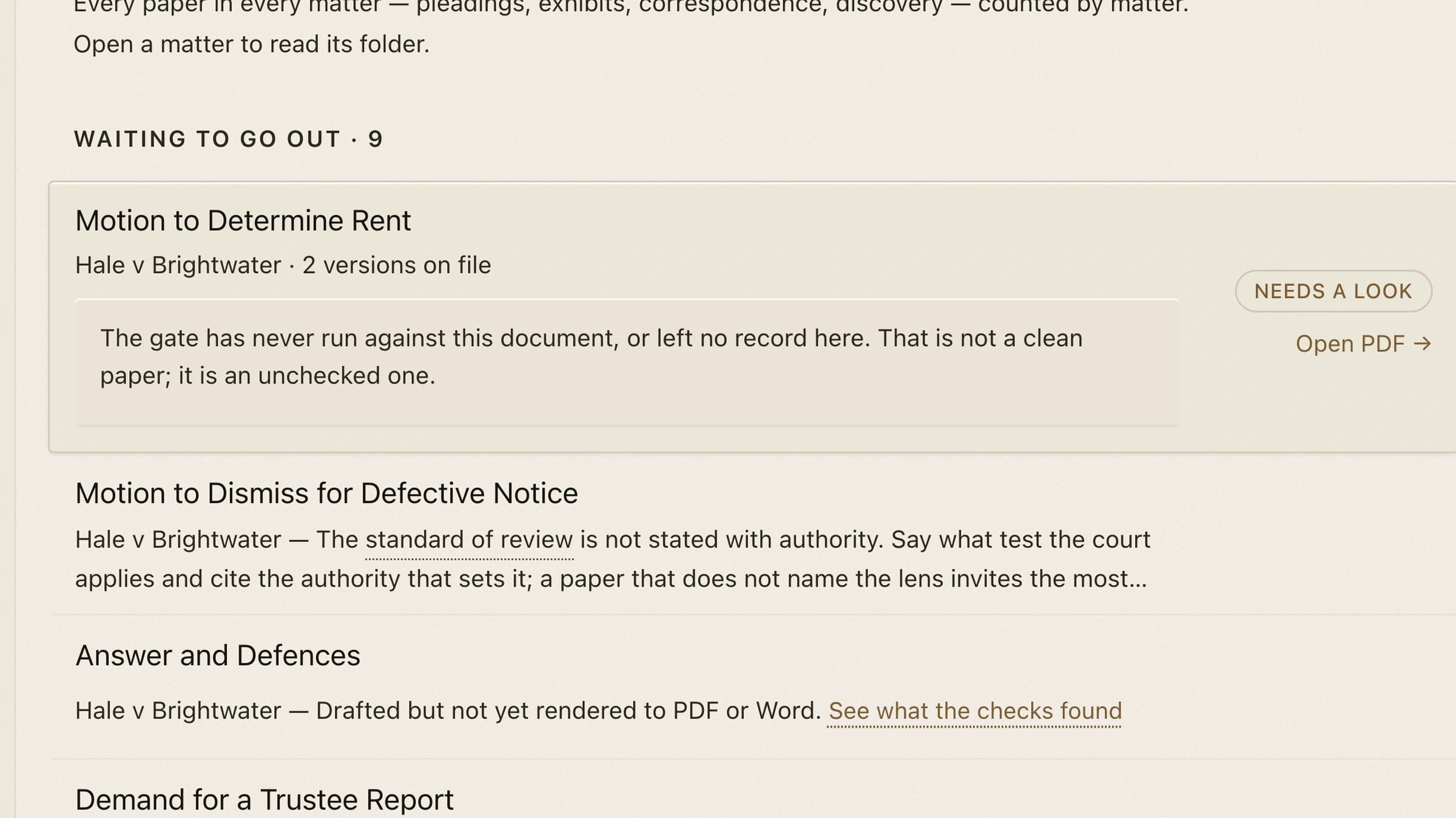
75 examinations stand between a draft and a court, and every one of them can stop it. A check that cannot finish blocks as well — an unfinished examination is never recorded as a clean one.
The part no one else will show you
It tells you the paper is not ready, and why.
Not a confidence score, and not a suggestion. The defect named the way the court would name it — and the document held back until it is cured.
The assembly line
36 actions, tracked and enforced on every matter.
The same stages a top litigation shop runs — except the system keeps the list, scores every action as done, pending, overdue or blocked at the gate, and never has to be asked whether a route was exhausted.
Preservation and litigation hold → adverse-party intelligence → limitations and tolling → complaint pleaded to each element → answer-admission extraction → initial disclosures → interrogatories, production and admissions → line-by-line scrutiny and a contradiction matrix → meet and confer → motions to compel, for sufficiency, for spoliation, for summary disposition, in limine → depositions and third-party subpoenas → expert retention → witness and exhibit books → pre-hearing brief → direct and cross outlines → post-hearing brief.
Compare memberships
The same engine on every plan. What changes is seats, sharing and where it runs.
| Membership | Individual$19 a month | Team$199 a month | EnterpriseBy arrangement |
|---|---|---|---|
| Active matters | Unlimited | Unlimited | Unlimited |
| Documents | Unlimited | Unlimited | Unlimited |
| Citation verification | Unlimited | Unlimited | Unlimited |
| Case management | Included | Included | Included |
| Drafting and filing | Included | Included | Included |
| Seats | 1 | 3 included | Unlimited |
| Shared matters and administration | Not included | Included | Included |
| API access | Not included | Included | Included |
| Deployment on hardware you own | Not included | Not included | Included |
How to begin
i
Request an invitation
Membership is by invitation. Ask for access, and we send you an invite code.
ii
Install the kit
Download your kit and run the installer. Every release is signed, and the signature is verified before it installs.
iii
Open the matter
Parties, docket and deadlines go in once. From then on the system carries them, and every session begins where the last one stopped.