Platform · The filing gate
Measured against the rule of the court it is going to.
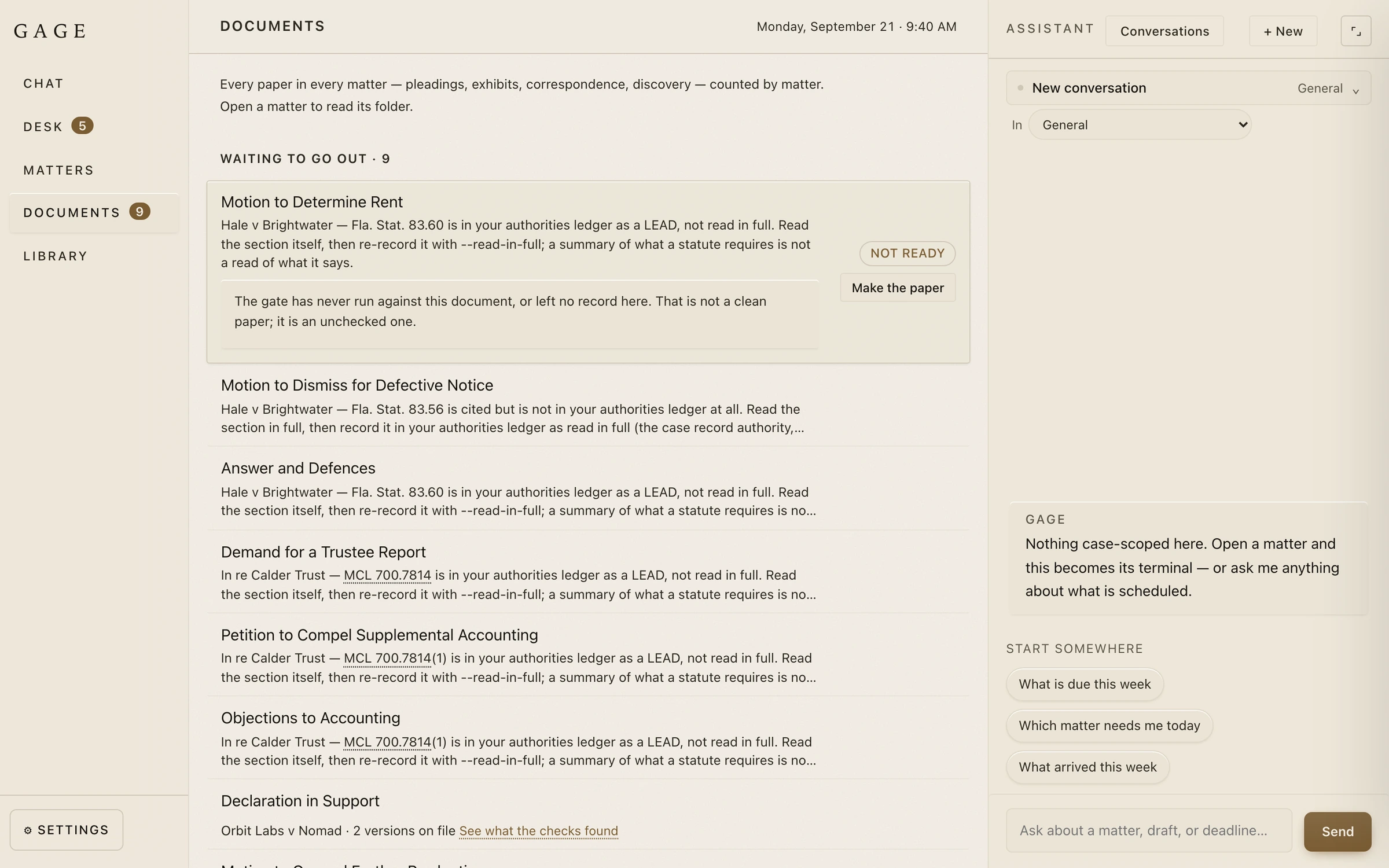
77 stages stand between a draft and a court, in 10 lanes, and every one is invoked on every paper. A draft that fails a stage does not leave, and a check that cannot finish blocks as well.
- 17 of 17
- invented citations caught before output
- 90 of 90
- citations verified at the reporter in a filed brief
- 88 of 88
- held-out drafting defects caught
What each lane refuses
Said as what gets stopped, not as a category. Counts are measured from the running gate.
77 stages · 10 lanes
- Authority and citation · 18No case is cited until the opinion has been read in full — not a headnote, not a snippet, not a summary. Each is then checked for what the majority actually held, whether the court reached it, and whether it is still good law.
- Argument and craft · 15The standard of review, who carries the burden and the relief sought are each stated with the authority that sets them. Every authority the other side cited is answered rather than left silent.
- Form, forum and filing · 11Caption, margins, page limits and the filing packet measured against that court’s own rule — and a refusal to draft into a court whose procedure we do not hold, rather than applying another state’s by default.
- Source and provenance · 8Every fact traces to the document it came from. A search result, an internal note or an earlier draft of our own is a lead to read, never a source to cite.
- Adversarial review · 7Someone goes looking for what kills the argument before opposing counsel does, including the authority that cuts against us.
- Exhibits and service · 5Exhibits numbered without collision, legible at the size they will be read, and reconciled against what the paper says was served on whom.
- Release control · 5Nothing regenerates after signature, and nothing leaves without the approval on the record. A signed paper is frozen.
- Parties and privacy · 3Every party’s identity and role verified from a primary source — no title inferred from a name — and personal data held out of what gets filed.
- Dates and clocks · 3No “next Tuesday”. Every deadline computed from the rule that sets it and carrying that rule’s citation, so a date can be checked instead of trusted.
- Numbers · 2Every figure reconciles against its exhibit, and any amount the court may ask about is on one page before anyone stands up.
Every safeguard proven before it ships
Each one is exercised against the specific defect it exists to catch, on material it was never built from, and watched failing before it is trusted to pass.
- 1,003 safeguards standing behind the engine
- 884 proven against the defect each one exists to catch
- 613 proven on material that was complete, well-formed and incorrect
Clean drafts are left alone
A gate that flags everything is ignored. On held-out clean drafts, 68 of 68 were passed without a false alarm.
Part of one system.
- Platform · DraftingDraftingPapers drafted to the forum, exhibit binders, and business paper checked against statute.
- Platform · ResearchResearchThe full opinions, not the headnotes: statute, rule, case law and equity, read in full.
- Solutions · Law firmsLaw firmsDockets, briefs and discovery at volume, every citation read in full before it reaches a partner.