Platform · Research
Research that reads the opinion.
Statute, court rule, binding case law, the equity behind them and the authority that runs against you, opened and read in full. A holding is never read alone, and a snippet never stands in for an opinion.

- 9,427,210
- court opinions, full text, across 989 reporters
- 77,481,570
- citation links between them
- 18,124,047
- reporter citations, every one resolved
Authorities are solved for, not accumulated.
Finding candidates is the easy half. The work is choosing among them, and showing the choice was the best one available rather than merely a good one.
Ten Stages Between a Question and an Answer
A question does not go to one search box. A citation is resolved at the reporter, the corpus is searched by its words and again by its meaning, the two rankings are fused, related authority is recalled, and the result is reranked, selected, grounded and scanned for negative treatment. Each stage can be checked on its own.
- A reporter citation is a lookup, never a search
- Words and meaning searched separately, then fused so neither hides the other’s best hit
- A citation absent from what was retrieved is flagged unsupported
The Answer Pipeline
- Fusionevery query
- Associative recall1,556,170 triples
- Authority selectionpool from 9,427,210 opinions
- Optimisation cross-checkevery solve
The Smallest Set That Covers the Argument
A brief does not need every case that agrees with it. Authority selection is posed as an optimisation and solved by quantum annealing, then checked against an exact solver.
- Minimum redundancy, maximum relevance
- Cross-checked by an exact oracle where the problem permits one
- The same pool the corpus figures above describe
Good Law, Before the Brief
A negative-treatment scan over the citation graph asks whether an authority has been overruled or superseded before it reaches a draft, not after. Treatment is read from the citing opinion itself, and an authority that has been limited is shown with what limited it.
- 77,481,570 citation links scanned for treatment
- Every citation resolved at the reporter
- A citation not in the retrieved context cannot be smuggled into an answer
Every Page of Your Own Matter, Searchable
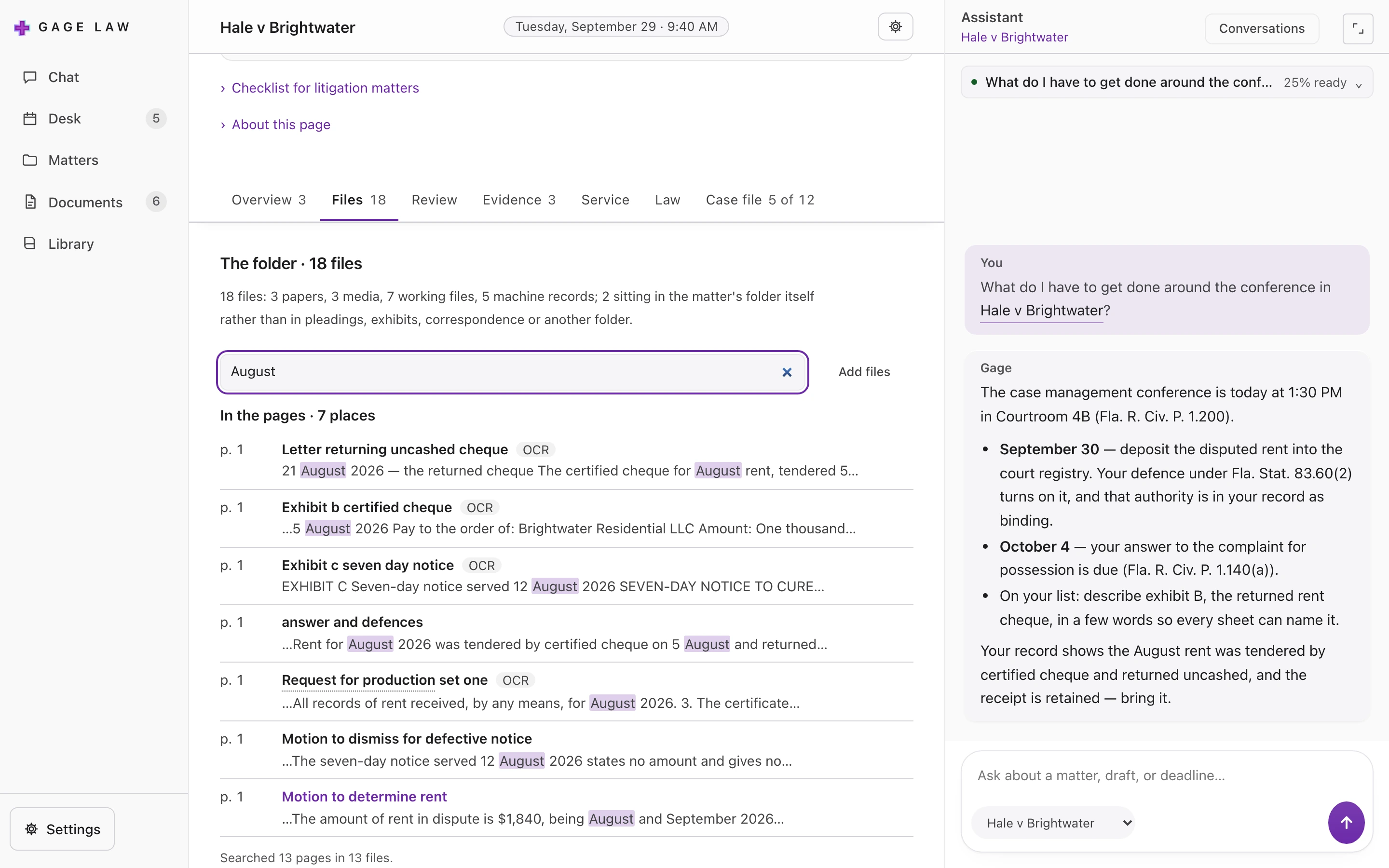
The matter’s own papers are read page by page, including the ones that are only images, and searched beside the law. A fact found there carries the page it was read from, so a statement in a draft can be walked back to the document that supports it.
- Pages that are only images are read from the image
- Anything that cannot be read is named, never skipped
- Your own record searched beside statute, rule and case law
The Law That Governed, Not Only the Law Today
Repealed and expired sections are kept and marked, because the law that governed the conduct is not always the law in force today. A treatise answers at the paragraph that actually holds the proposition, not at the spine of the book, and authority is weighed by court, jurisdiction and treatment.
- Statutes read in the version that governed the conduct
- A proposition resolved to the paragraph that holds it
- A strong source in one forum may be weak in another
An Answer That States Its Coverage
A result is never a bare value: it states what was searched and what was not. An empty search returns unknown, never “nothing found”, and where authority is missing or conflicting the gap is queued for research instead of being filled with unsupported language.
- What was searched, stated beside the answer
- A source that could not be reached is marked unreached and cited by no one
- Missing authority queued for research, never papered over
One system, end to end.
Research is one part of it. The same record, the same reading and the same standard run through every matter the system carries.
Research · this page
9,427,210 opinions and 77,481,570 citation links, with statute, court rule, equity and the constitution read in full, never from a headnote.
Drafting
Complaints, motions, answers, declarations and letters framed only from what was read, in the form the forum expects.
The Filing Gate
Every paper measured against the rule of the court it is going to, behind 1,327 safeguards. A paper that fails is not rendered.
Evidence and the Record
Productions taken whole, exhibits bound and numbered, discovery graded against the forum’s own standard in 7 forums.
Hearing Preparation
The script you read, what to say at fourteen courtroom moments, and every number the court may ask for on one page, all from your own papers.
Watched Overnight
The court’s record of each matter watched, mail read into the matter it belongs to, and official letters held for business hours.
Deadlines and the Timeline
Every date carries the rule that sets it, every event lands on one timeline, and the desk says what is due before it is late.
Service of Process
Every party to be served, the method the forum allows, quotes per stop, each server’s record, and the proof back on file.
Negotiation and Settlement
A matter priced as a range with its bad tail, a whole concession ladder modelled, and a negotiation scored before it is held.
Contracts and Business Paper
Each instrument read against the statute that makes it enforceable, and benchmarked against 80,000 provisions from SEC EDGAR material contracts.
Trusts, Estates and Fiduciaries
Trust instruments, fiduciary duties and the administration record kept to the standard a court applies years later.
Entities and Networks
People, companies and their relationships mapped from the primary record, with every connection traced to the source that shows it.
Mail
Your own email read, written and filed to the matter from the desk. The assistant can draft; nothing is sent until you press Send.
The Desk
Every matter and what it needs today, kept on your own computer.
Published Research
Research papers built the same way: no claim without the primary source that proves it.